

Whatly
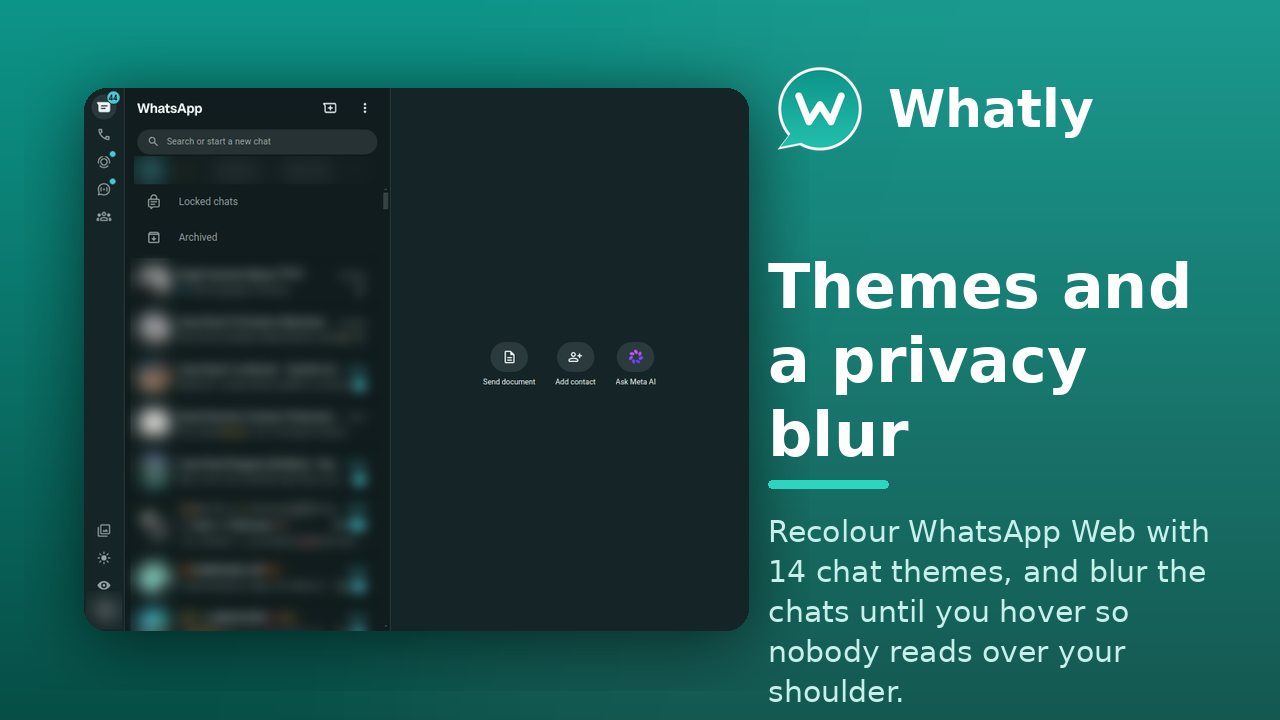
Whatly is a native desktop wrapper for WhatsApp Web, built on Qt and QtWebEngine. It brings WhatsApp out of the browser tab and into a proper desktop application with system integration, privacy controls, and customization options unavailable in a plain browser.
This is a fork maintained by Ángel Guzmán Maeso, based on the original WhatSie created by Keshav Bhatt and released under the MIT licence.
Core features:
- Multiple WhatsApp accounts: as separate windows or as tabs in one window, each with its own session and settings
- Scheduled messages, sent later and delivered on the next launch if the app was closed when they came due
- Fourteen chat themes, a chat wallpaper and custom CSS
- Privacy blur that hides the chat list and open conversation until you hover
- Choose the font family WhatsApp Web renders in, plus an adjustable interface font size
- Spell checker with 31 languages, several checked at once
- App lock with PIN protection and a configurable auto-lock timeout
- Light and Dark themes, optionally following the system preference live
Desktop integration:
- Native system notifications and custom in-app notification popups
- System tray with an unread badge, an optional monochrome icon and a connection-status indicator
- Unread count shown on the taskbar (Unity LauncherEntry: KDE, Dash-to-Dock and others)
- Connection watchdog that reloads a stalled session, and optional automatic reload after a page crash
- Global keyboard shortcuts and a built-in download manager
- Per-session audio mute and notification suppression
- HiDPI/4K scaling, configurable zoom and a custom user-agent string
- Runs on Linux and Windows (plus an experimental macOS build); interface translated into 30 languages
Compatibility: Uses the C library of the system (may need glibc 2.34 or later)
GitHub Download Whatly Website Whatly Bugtracker Donate
Usage
Whatly is available as an AppImage which means "one app = one file", which you can download and run on your Linux system while you don't need a package manager and nothing gets changed in your system. Awesome!
AppImages are single-file applications that run on most Linux distributions. Download an application, make it executable, and run! No need to install. No system libraries or system preferences are altered. Most AppImages run on recent versions of Arch Linux, CentOS, Debian, Fedora, openSUSE, Red Hat, Ubuntu, and other common desktop distributions.
This AppImage uses the C library of the system and may need glibc 2.34 or later. It does not run on distributions that use a different C library (such as musl on Alpine Linux) or an older glibc.
Running Whatly on Linux without installation
Unlike other applications, AppImages do not need to be installed before they can be used. However, they need to be marked as executable before they can be run. This is a Linux security feature.Beware! AppImages are usually not verified by others. Follow these instructions only if you trust the developer of the software. Use at your own risk!
Download the Whatly AppImage and make it executable using your file manager or by entering the following commands in a terminal:
chmod +x ./*.AppImageThen double-click the AppImage in the file manager to open it.
Sandboxing Whatly
If you want to restrict what Whatly can do on your system, you can run the AppImage in a sandbox like Firejail. This is entirely optional and currently needs to be configured by the user.
Updating Whatly
If you would like to update to a new version, simply download the new Whatly AppImage.
The Whatly AppImage also can be updated using AppImageUpdate. Using this tool, Whatly can be updated by downloading only the portions of the AppImage that have actually changed since the last version.
Integrating AppImages into the system
If you would like to have the executable bit set automatically, and would like to see Whatly and other AppImages integrated into the system (menus, icons, file type associations, etc.), then you may want to check the optional appimaged daemon.
Note for application authors
Thanks for distributing Whatly in the AppImage format for all common Linux distributions. Great! Here are some ideas on how to make it even better.
Pro Tips for further enhancing the Whatly AppImage
Please consider making the Whatly AppImage self-contained, so that it does not depend on the C library of the system and runs on more distributions: ship the C library including its loader (ld-linux-*.so.*) and use it to launch the application, or link statically.
Thanks for shipping AppStream metainfo inside your AppImage. Please open a pull request on https://github.com/AppImage/appimage.github.io/blob/master/data/Whatly if you have changed it and would like to see this page updated accordingly.