

jsCPUInspector
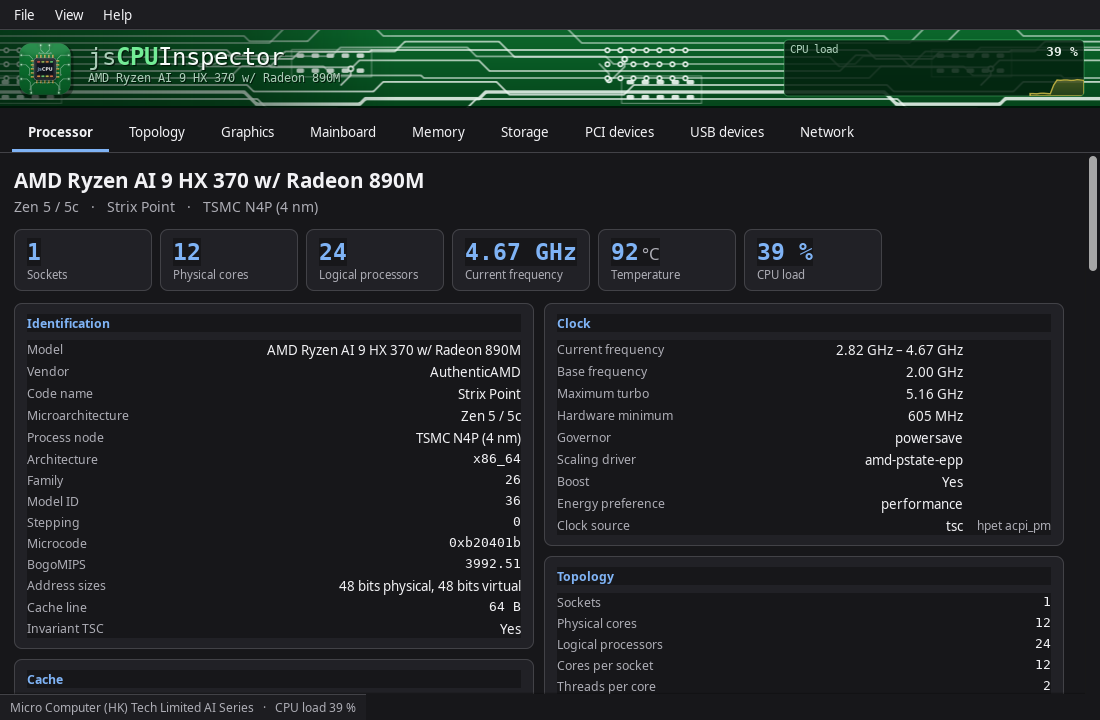
Nine tabs, one window: what processor is in this computer, how it is laid out, which graphics unit it has, what mainboard it sits on, what memory is installed, which drives are built in, and what is attached over PCI, USB and the network. Sockets, cores and threads, cache sizes, code name and manufacturing process, BIOS and chipset, and every memory module with its own speed and part number.
- A grid of every core with its own clock speed and load, updating live
- Cache levels drawn to scale, with what shares them
- Code name, microarchitecture and manufacturing process
- The graphics unit in the processor with its compute units and clocks
- Every memory slot: size, type, speed, part number — and which ones are free
- Drives, PCI devices, USB devices and network interfaces, each on its own tab
- Saves everything as a text file, useful for a support request
- 44 languages, light and dark theme, all colours adjustable
Compatibility: Uses the C library of the system (may need glibc 2.34 or later)
Usage
jsCPUInspector is available as an AppImage which means "one app = one file", which you can download and run on your Linux system while you don't need a package manager and nothing gets changed in your system. Awesome!
AppImages are single-file applications that run on most Linux distributions. Download an application, make it executable, and run! No need to install. No system libraries or system preferences are altered. Most AppImages run on recent versions of Arch Linux, CentOS, Debian, Fedora, openSUSE, Red Hat, Ubuntu, and other common desktop distributions.
This AppImage uses the C library of the system and may need glibc 2.34 or later. It does not run on distributions that use a different C library (such as musl on Alpine Linux) or an older glibc.
Running jsCPUInspector on Linux without installation
Unlike other applications, AppImages do not need to be installed before they can be used. However, they need to be marked as executable before they can be run. This is a Linux security feature.Beware! AppImages are usually not verified by others. Follow these instructions only if you trust the developer of the software. Use at your own risk!
Download the jsCPUInspector AppImage and make it executable using your file manager or by entering the following commands in a terminal:
chmod +x ./*.AppImageThen double-click the AppImage in the file manager to open it.
Sandboxing jsCPUInspector
If you want to restrict what jsCPUInspector can do on your system, you can run the AppImage in a sandbox like Firejail. This is entirely optional and currently needs to be configured by the user.
Updating jsCPUInspector
If you would like to update to a new version, simply download the new jsCPUInspector AppImage.
The jsCPUInspector AppImage also can be updated using AppImageUpdate. Using this tool, jsCPUInspector can be updated by downloading only the portions of the AppImage that have actually changed since the last version.
Integrating AppImages into the system
If you would like to have the executable bit set automatically, and would like to see jsCPUInspector and other AppImages integrated into the system (menus, icons, file type associations, etc.), then you may want to check the optional appimaged daemon.
Note for application authors
Thanks for distributing jsCPUInspector in the AppImage format for all common Linux distributions. Great! Here are some ideas on how to make it even better.
Pro Tips for further enhancing the jsCPUInspector AppImage
Please consider making the jsCPUInspector AppImage self-contained, so that it does not depend on the C library of the system and runs on more distributions: ship the C library including its loader (ld-linux-*.so.*) and use it to launch the application, or link statically.
Thanks for shipping AppStream metainfo inside your AppImage. Please open a pull request on https://github.com/AppImage/appimage.github.io/blob/master/data/jsCPUInspector if you have changed it and would like to see this page updated accordingly.
If you would like to see a donation link for the application here, please include one in the AppStream data.